


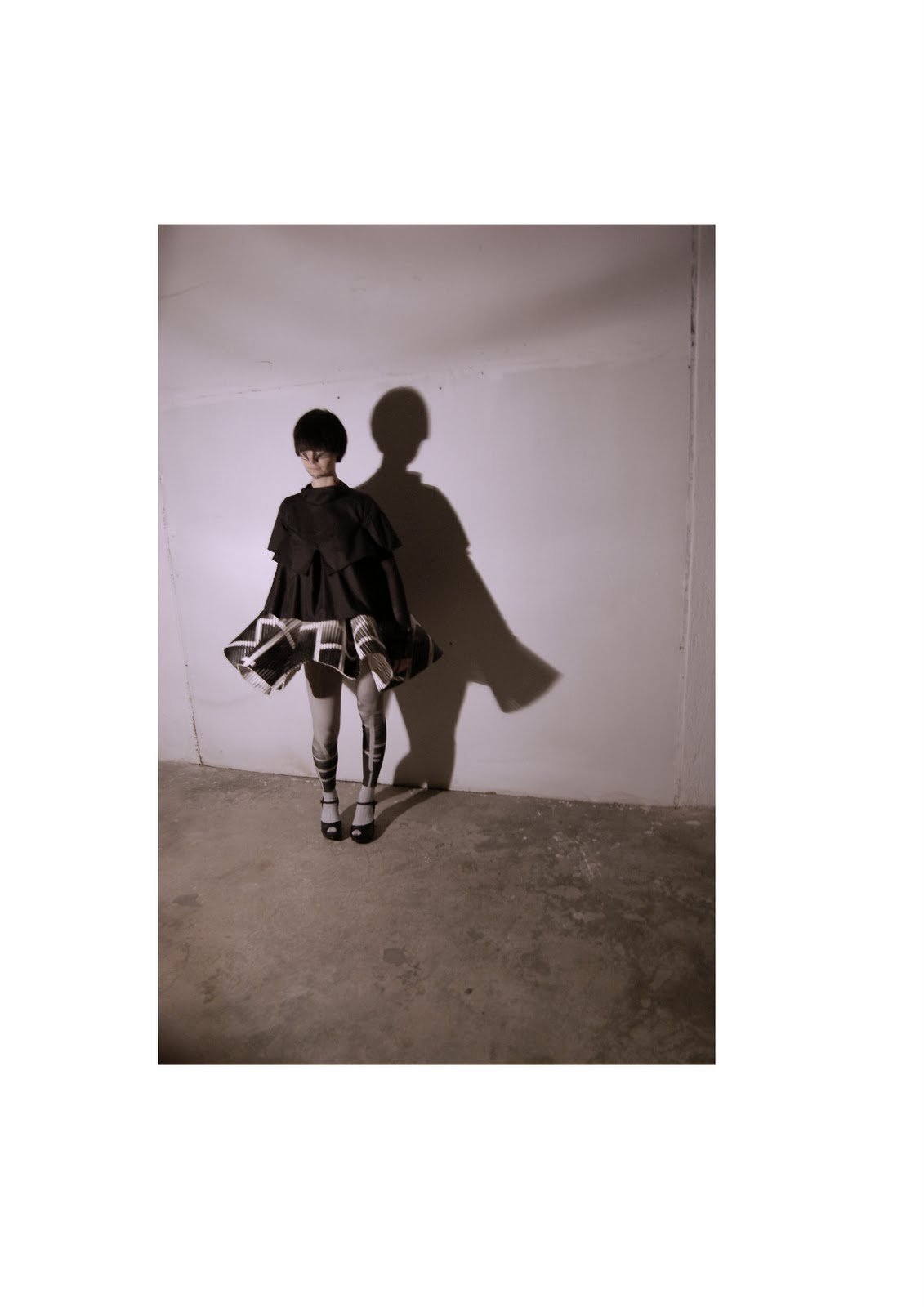
My project is the result of a thought process I elaborated during the making of my last collection. The Maori culture has been my first visual reference: the project explores the impressive structure and majesty of their bodies and the drawings of their tattoos through the creation of large volumes and regular, symmetric cuts. The fetish aesthetics (my contemporary reference) helped me to transform these irregular decorative tattoos in sharp, severe lines and marks, giving the spectator a first suggestion of artificial aggressiveness, that has been emphasized by the choice of materials such as rubber, leather and shiny, black fabrics. While choosing the definitive sketches, I decided I wanted the outfits to be perceived into a kind of hierarchic scale, so I imagined the chessboard as the right milieu where to identify their role. In so doing I could work in a ludic way, since I was relating with pawns, not real people. Moreover the chessboard is a symmetric, ordered microcosm, where intellectual violence breaks out, where the dramatic force of fetish and the Maori solemnity can finally live together.
The obsession for symmetry and doubles developed while reading the carrollian masterpiece Through the looking Glass, shifting later on the composition of my first photo shooting. By reflecting these images symmetrically I also could suggest the absence of humanity, a mood belonging to my muse and audio support Fever Ray.
I then choose four of the eight pawns (tower, knight, bishop and king) where I traced new axis of symmetry, which inclination followed the direction of their move, that is their role. I actually was inspired by the words of Duchamp: “pawns are the printed alphabet that shape our thoughts and express beauty in an abstract way, through an ideographic execution of a move”. As a matter of fact, these new four outfits represent the drawing of new paths and new shapes, and, meanwhile, the break of the initial order of a match.
After an aesthetic thought on chess and a ludic one on my collection, I tried to move these considerations on a more general level: can Fashion and Game be interdependent? Referring to the text Man, play and games by Roger Caillois I found out they are the foundations of communication and culture, and they both include a factor of masking and identification (the so-called mimicry).



.jpg)


 Memento crescere takes inspiration from the motto “memento mori”(“remember you have to die”). Literally translated, my motto means “remember you have to grow”, since my uniform encloses two opposite concepts: the memento itself, referring to something happened in the past, and growth, an action which is addressed to the future. It is a symbolic representation of an inevitable growth , which, facing time’s irreducibility, shows its need of reappropiation of the past; this growth has been intended as a stalagmite, a series of cumulative experiences and life stages represented by different layers of the dress, which are bound together by press studs. The work suit becomes habitus, a for-ever-and-ever shelter.


